The Business Problem: Cold Traffic With Nowhere to Land
I built this as a contest entry inside a bootcamp run by Pareto Talent. The brief was a real one: design the lead magnet for Pareto's own funnel, from ad to sales call. It never ran on paid traffic, so this is the story of the thinking and the build, not of the numbers.
Pareto Talent finds, trains, and places executive assistants from Latin America (they call them "right hands") with US founders doing $500K+ a year. Every sale starts with one conversation: the Matching Call.
The company wants to run paid ads to founders who have never heard of it. The catch: a cold founder isn't ready to book a sales call, and there was nothing in between. No reason to leave an email, and no way to tell a qualified founder from a curious one before the sales team spent time on a call.
The Insight: Founders don't put off this hire because they doubt they need help. They put it off because they don't know who to hire or what they'd hand over. One client put it better than I could: "The reason I need them is because I don't have time. And the reason I can't find them is because I don't have time." So the lead magnet had to remove that uncertainty in minutes, and lead straight into the call.
Mapping the Journey Before Designing a Single Page
Before deciding what the lead magnet would be, I mapped the whole path from ad to call. That way every later decision had a job to do in the system, not just on the page.
- One qualifier: annual revenue, with the line at $500K, Pareto's ideal-client floor. It's the only thing that routes a lead.
- Two lanes: qualified founders go to a booking page and the Matching Call. Everyone else gets a thank-you page and nurture emails that bring them back when they're ready.
- Recovery loops: founders who qualify but don't book get a call or SMS, then an email. No-shows get a same-day rebook message.
- What I cut: my first draft had six traffic sources, a referral fast lane, retargeting, and a third "not a fit" lane. I cut all of it so the first version could ship in days. Any of it can come back once there's data saying it's worth it.

Research: What Everyone Else Gives Away
I broke down the lead magnets of Pareto's three closest competitors on five points: format, promise, audience, how it qualifies, and what happens after opt-in. One used a quiz that scores the founder's delegation skills, one generated an automated "time freedom" report, and one offered ROI calculators with no email gate.
- Everyone ends at a call. The lead magnet's real job is to warm up and qualify a lead before a sales conversation.
- Personalization wins. Each one hands the founder something about their own situation: a level, a report, or a number.
- The gap: none of them showed the founder a picture of the person they actually need. That became the opening.
Choosing the Format: A Sample of the Real Product
I worked through the lead magnet in five decisions, one at a time: format, promise, title, qualification, and the next-step offer. For the format, I weighed four options:
- A "how well do you delegate" quiz: rejected as the main hook, because a competitor already owns it.
- "Meet your 3 matches" before the call: rejected because it would be dishonest. Real matches need the call, a behavioral assessment, and a human review.
- A delegation template kit: easy to build, but it qualifies no one, and it mostly helps the founders who'd rather do it themselves.
- A free audit done by a right hand: high value, but too slow and costly to give every lead.
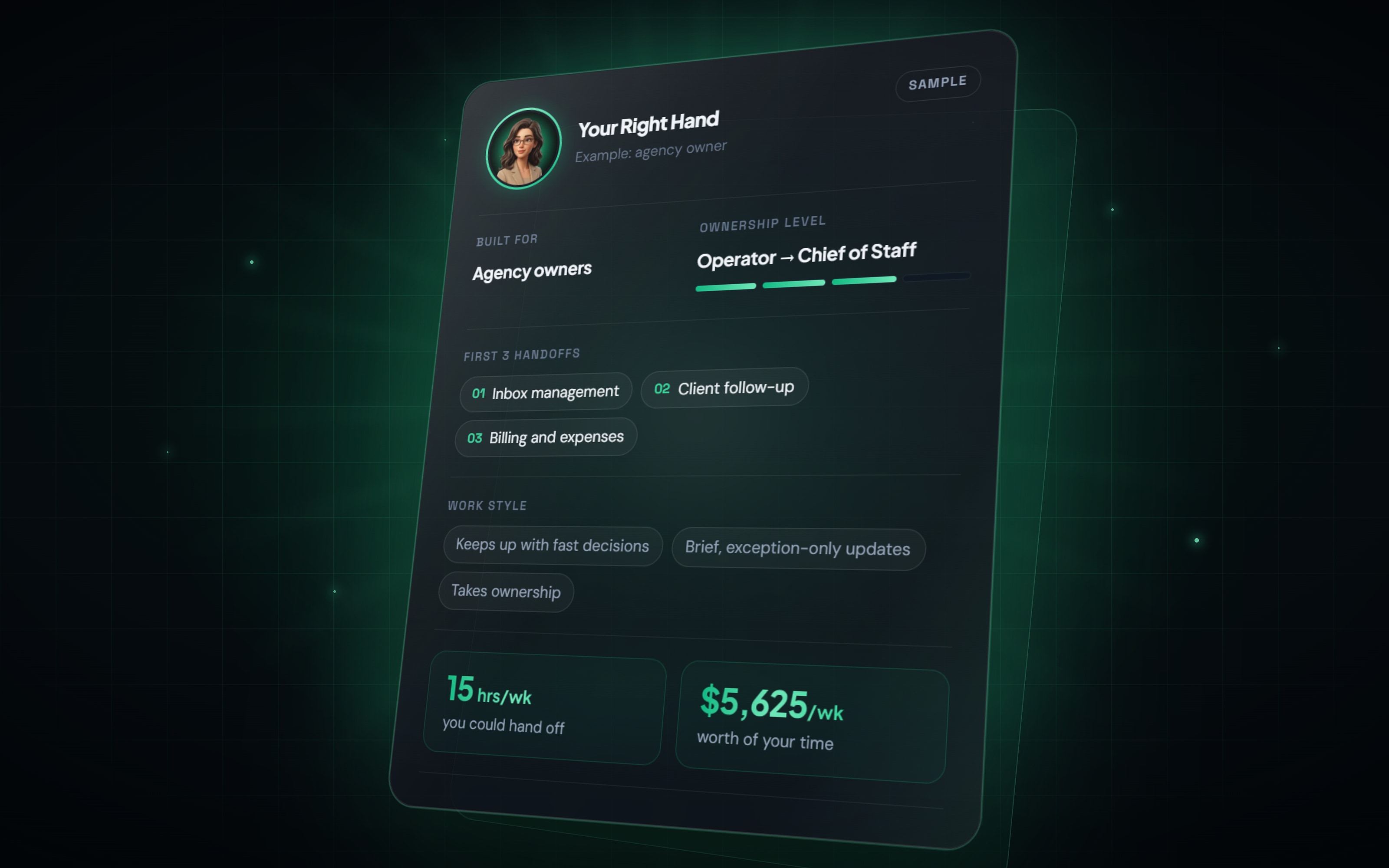
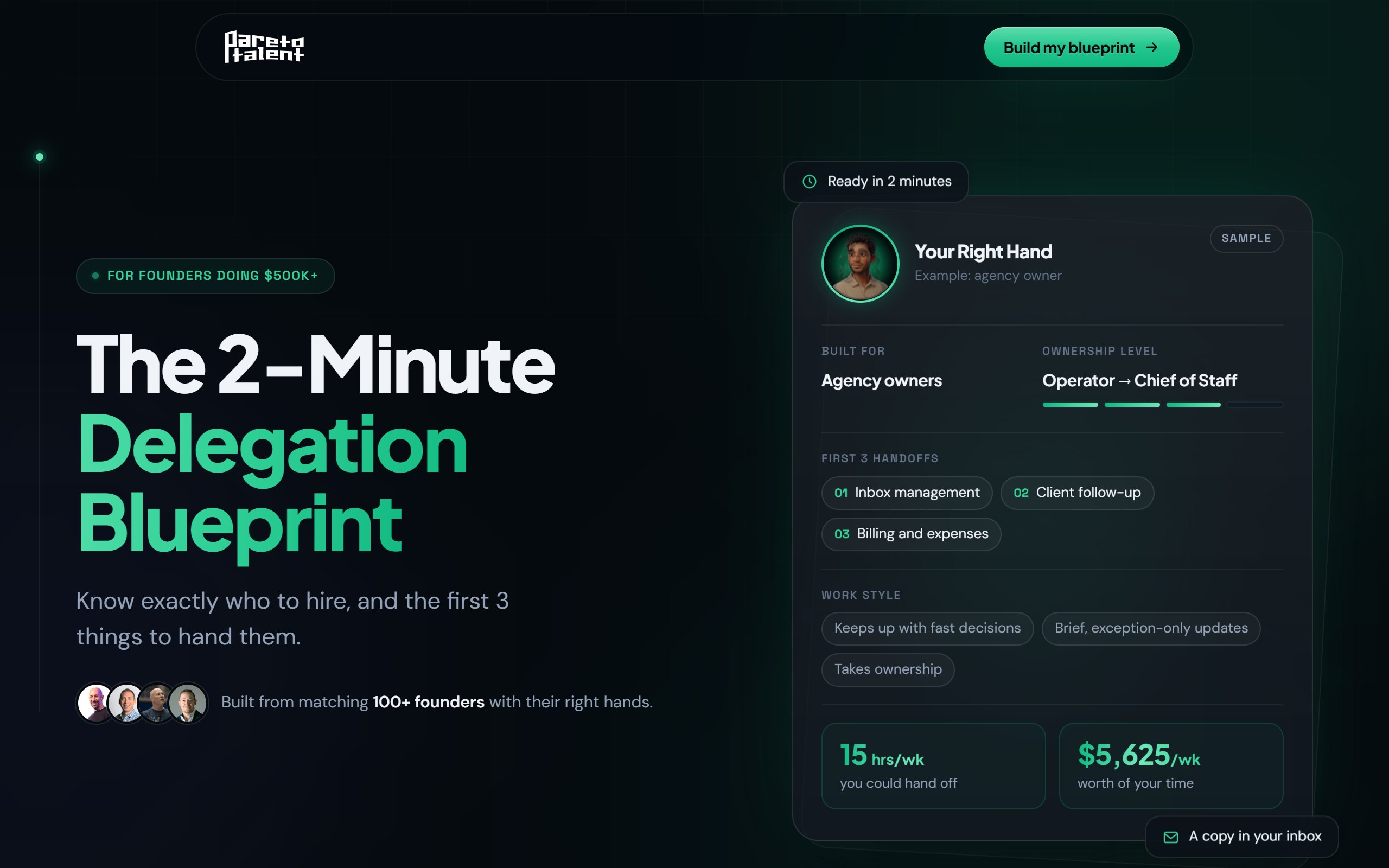
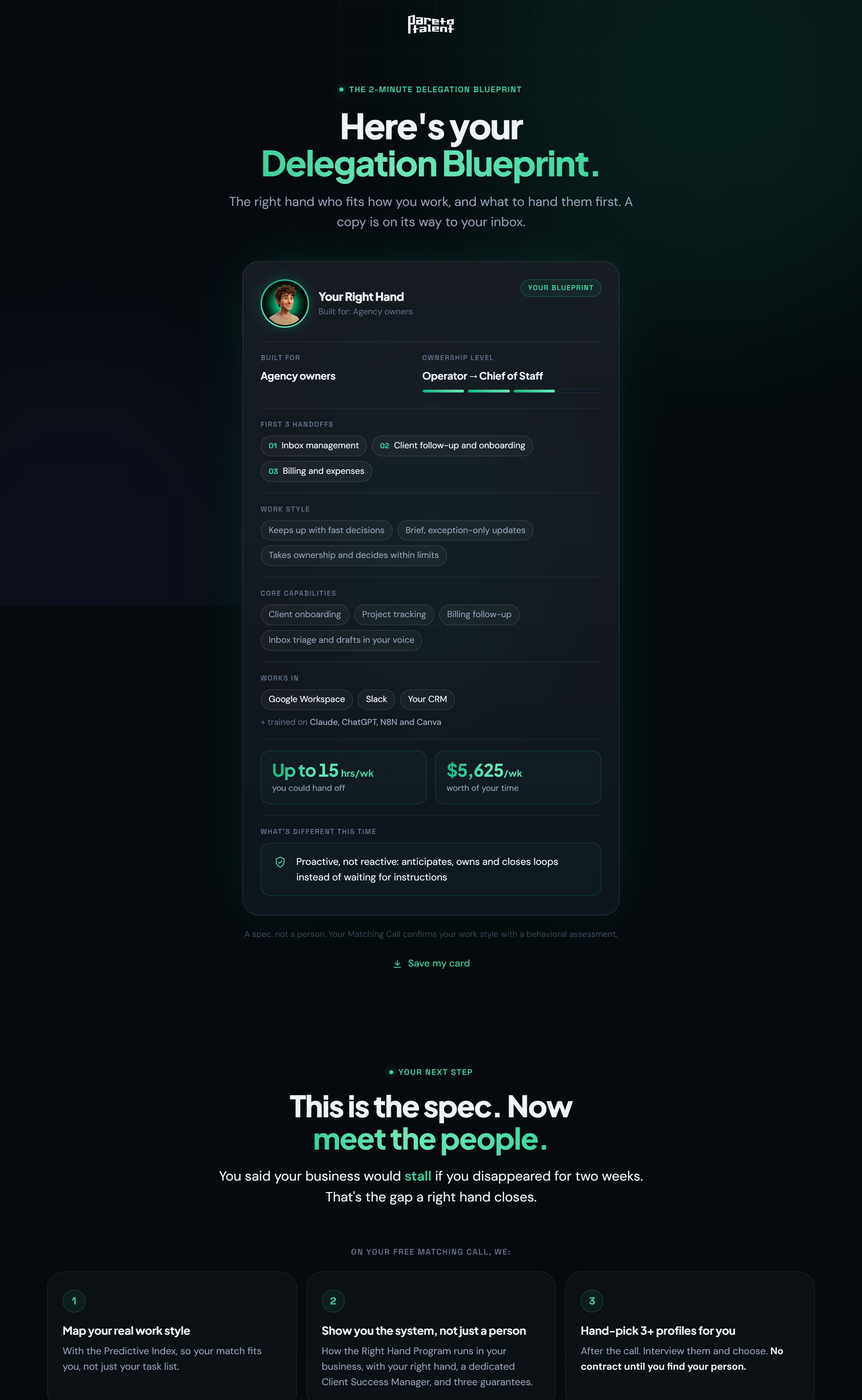
The Decision: a 10-question quiz that builds a spec card of the founder's ideal right hand: work style, skills, tools, and the first three areas to hand off. It's a sample of what Pareto actually sells (the matching), delivered as software.
It also set one honesty rule I designed around for the rest of the project: the card is a spec, never a person. It has no name, uses an illustrated avatar, and never implies that matches have already been found.
The name followed from the promise: The 2-Minute Delegation Blueprint, "Know exactly who to hire, and the first 3 things to hand them." I picked "Delegation" over Pareto's house term "right hand" because cold traffic understands it without any context. "Right hand" shows up inside the quiz, once the founder is already invested.
Designing the Questions: Every Answer Builds Something
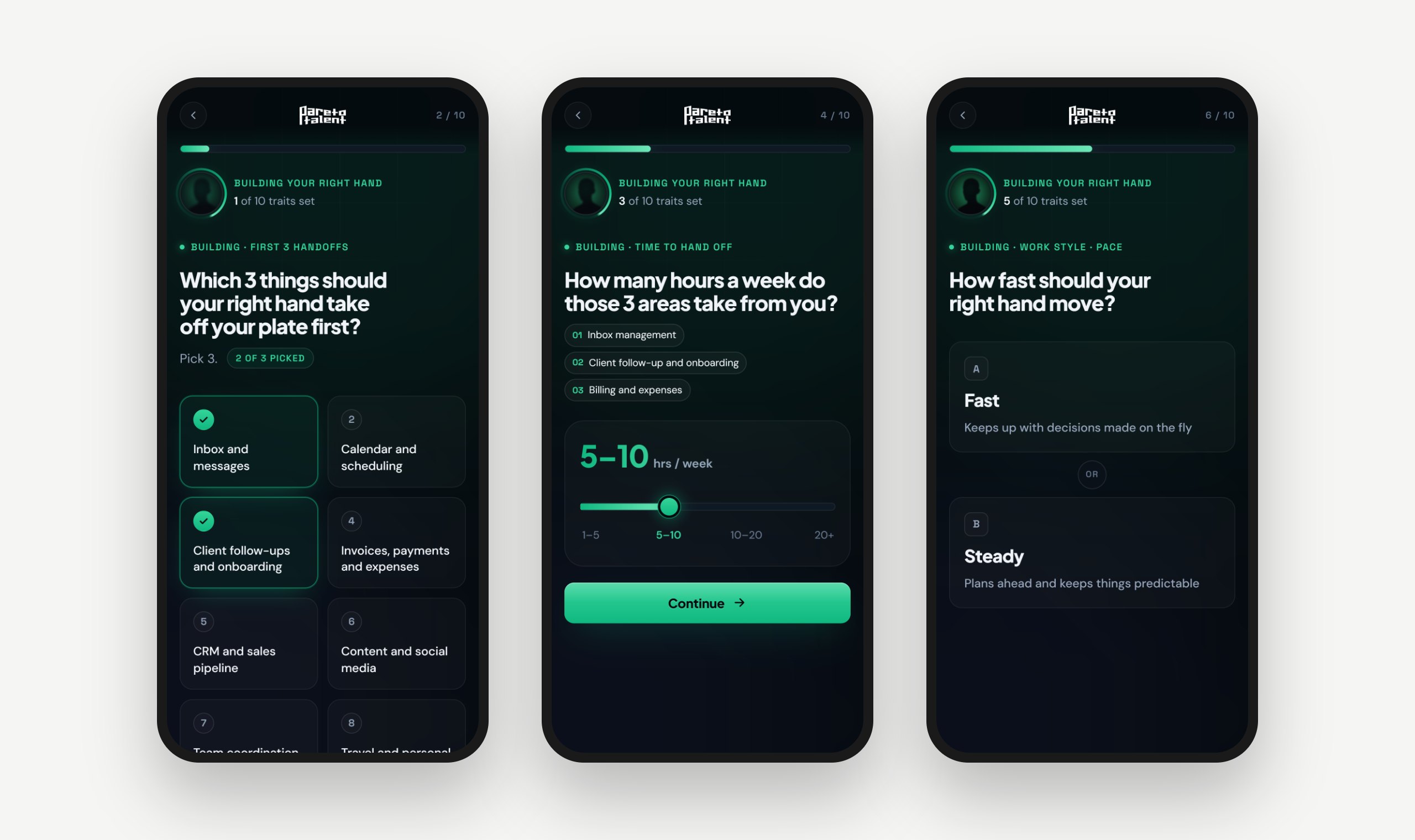
I designed the result card first and worked backwards, so every question had to earn its place by filling a field on the card. If a question didn't change the output, it was cut.
- Varied, tap-only inputs: lists, "pick 3" tiles, 4-stop sliders, and A/B choices keep the rhythm moving and the quiz under two minutes on a phone, which is where ad clicks land.
- Honest math: hours per week × the value of an hour gives a weekly figure ("15 hrs/wk you could hand off, worth $5,625/wk"). It says "could hand off", never "will get back", so it never reads as a guarantee.
- Tight scope: timeline moved to the booking page (only qualified founders need it) and role moved to the call. That kept the quiz at exactly 10 questions, matching the "10 quick questions · 2 minutes" promise on the button.
Iteration: From Diagnosing the Founder to Building a Person
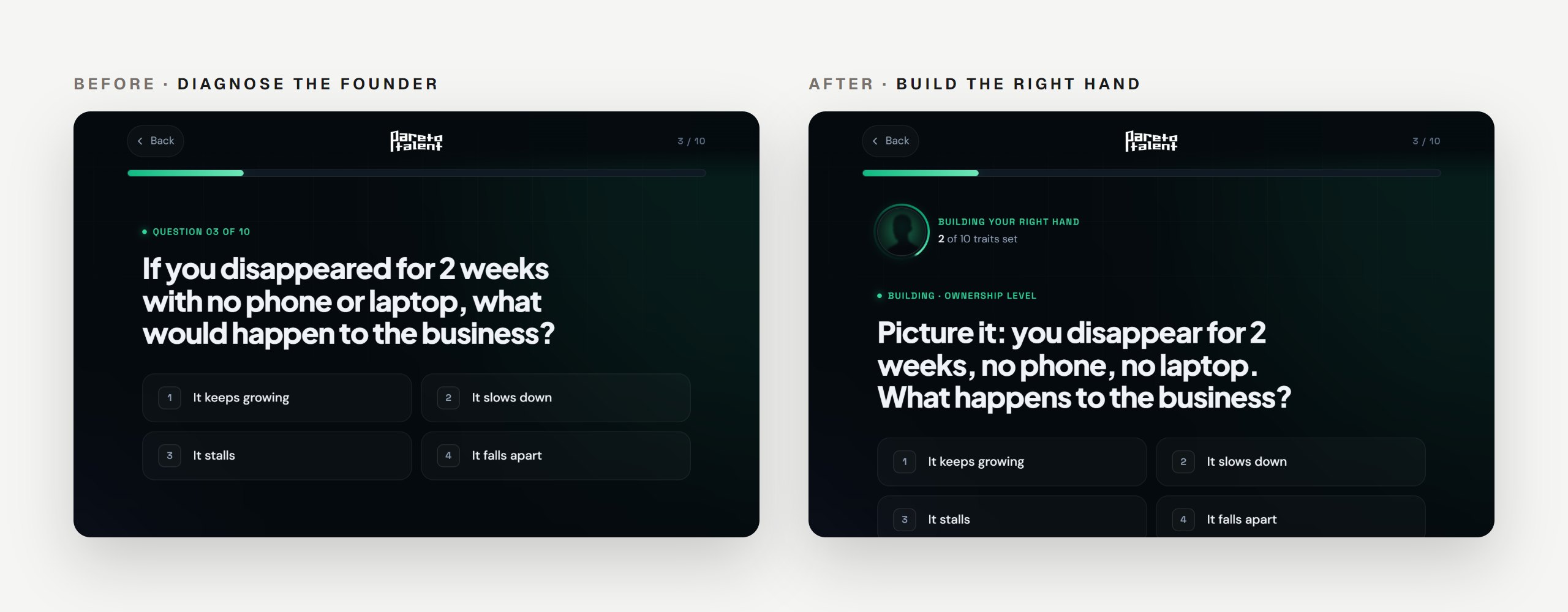
The first working version read like a test the founder was taking (and nobody clicks an ad hoping to get graded). It also looked too close to an older audit tool on Pareto's own website. So I kept every answer option and every mapping on the card the same, and changed only the frame.
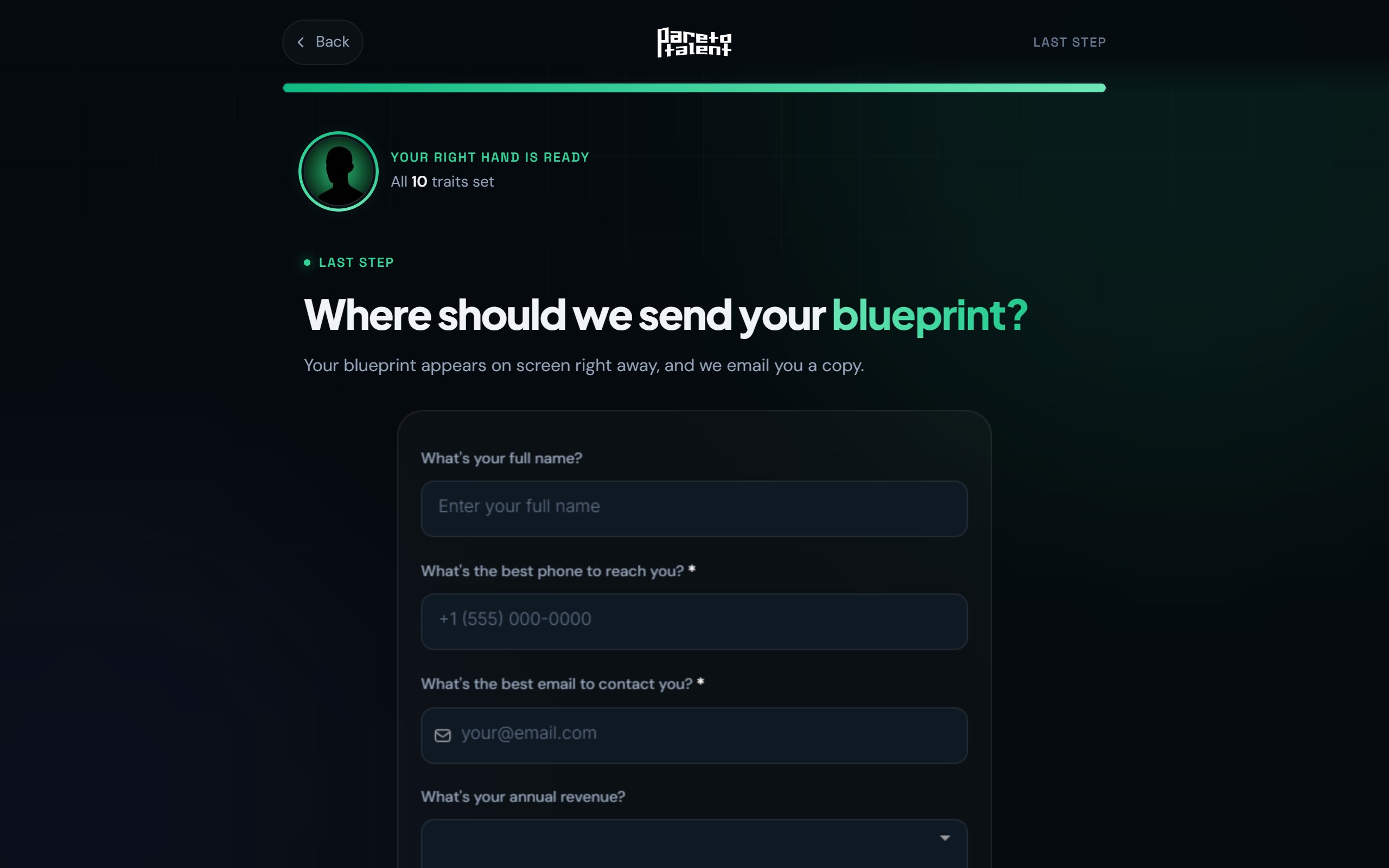
In v2, the founder isn't being assessed; they're building their right hand. Each screen names the trait it's setting ("Building · Ownership level"), and a silhouette in a progress ring fills in as answers come in, until "Your right hand is ready" appears right before the contact form. Same questions, a totally different feeling: momentum and ownership instead of judgment.
The Result: Give Away the What, Sell the How
The result page is where the lead magnet hands off to the sale. An early draft promised the founder their profile and first handoffs again on the call, but the quiz had already given those away. So I set a rule: the quiz gives away the what and the who; the call sells the how and the actual people.
- The card: "Your Right Hand", with an avatar picked from the founder's answers, so the same answers always give the same face.
- The bridge: a line built from the founder's own answer ("You said your business would stall if you disappeared for two weeks. That's the gap a right hand closes.").
- The offer: three things only the call can give (a real work-style assessment, the full system behind the person, and hand-picked profiles), with the booking calendar on the same page.
Two Lanes, No Dead Ends
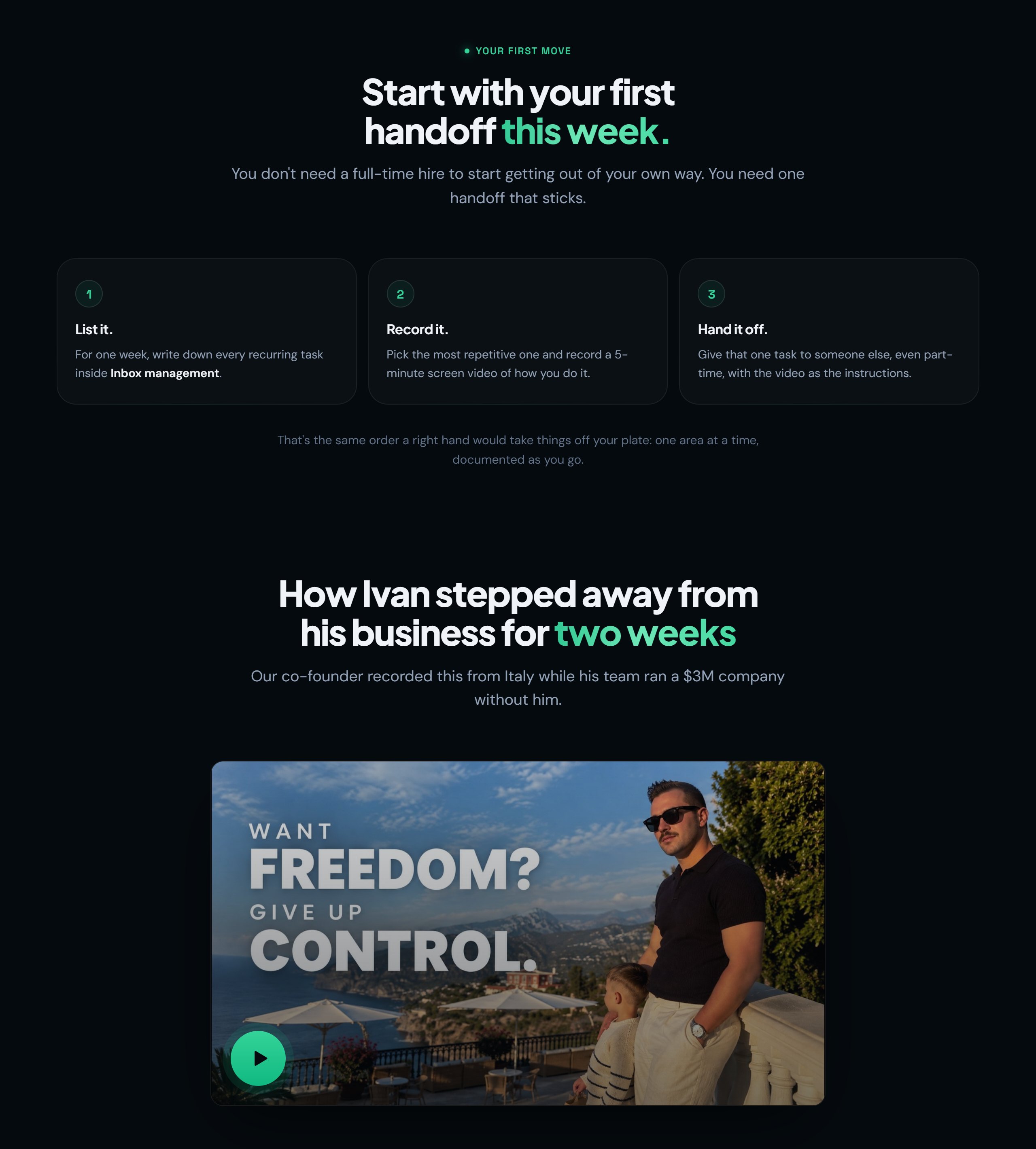
Founders under the revenue line still get their full blueprint. Instead of a calendar, their page gives them a first move they can make this week (list it, record it, hand it off) and a video of Pareto's CEO stepping away from his business for two weeks. Nurture emails then bring them back to the quiz when they're ready.
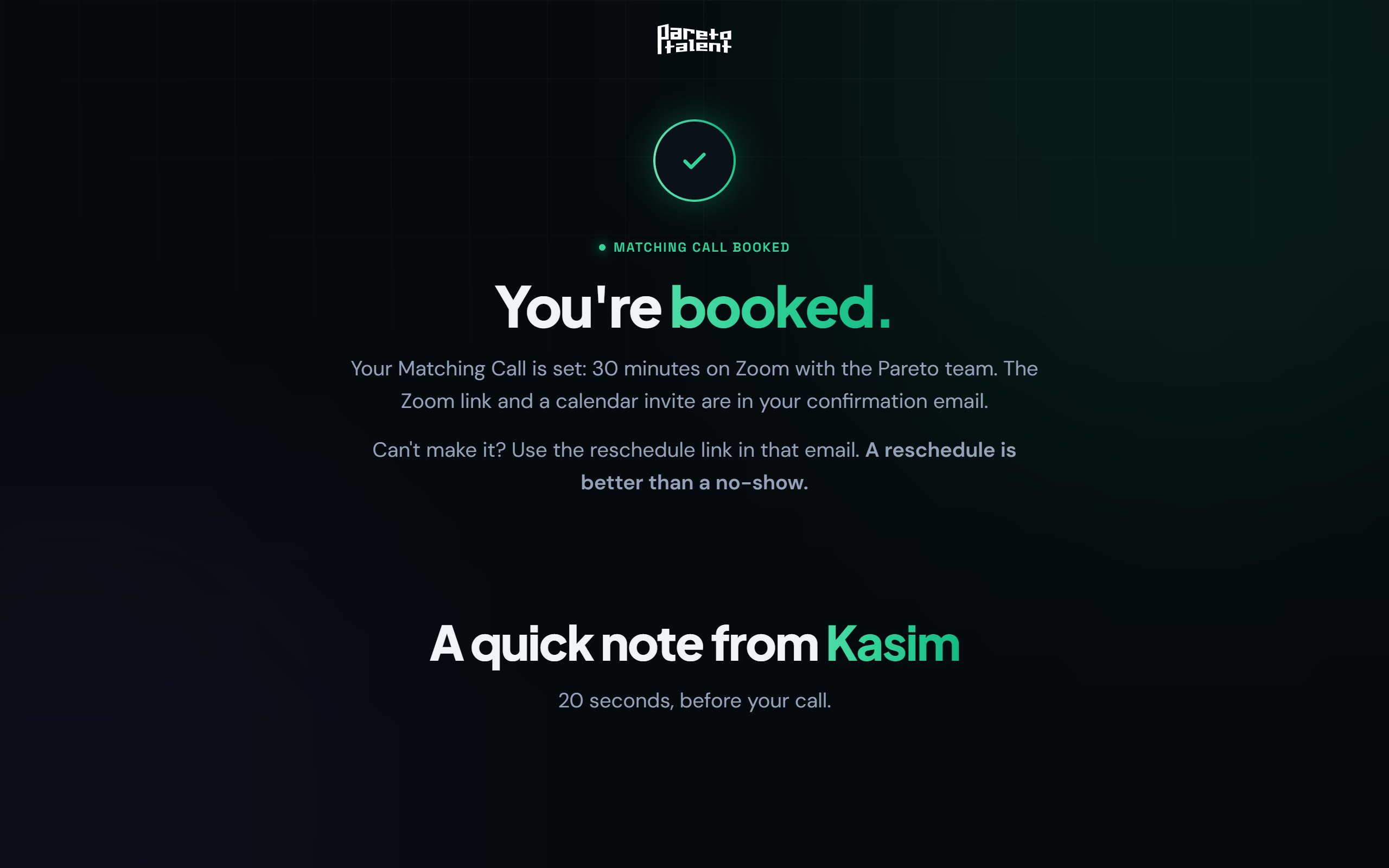
Founders who book land on a confirmation page with a short welcome video from Pareto's co-founder, plus prep and what to expect, so they show up warm. Around the pages I wrote the follow-up sequence by email and SMS (blueprint delivery, confirmation, reminders, didn't-book nudges, a no-show rebook, and nurture) and five Meta image ads, each with one persona and one angle.
Designing in Code With AI
Instead of handing off static mockups, I designed directly in the browser, building every page with Claude Code. That changed how I could work as a designer:
- Real iterations, not pictures of them: I tested copy, motion, and flow in a real browser, on desktop and mobile, as I made them. A reframe like v1 to v2 never had to wait for a design-to-dev handoff.
- One brand, not a lookalike: the pages use paretotalent.com's design tokens (dark surfaces, a single emerald accent, glass cards, slow blur-up reveals), so the funnel feels like part of the main site.
- Real integrations: the contact form is a GoHighLevel embed that receives the quiz answers as 9 hidden fields. The revenue question stays in that form because a CRM automation branches on it, and the pages read the answer back to send each founder to the right lane.
- Polishing the seams: third-party embeds rarely look native (and this one definitely didn't on the first try). I removed GHL's forced scrollbars and wrappers, restyled the form to match the brand, and pre-filled the booking calendar with the founder's name and email so they never type them twice.
I ran the build like a launch: a work breakdown in seven milestones with a critical path, tracked in ClickUp, a QA pass across both lanes and the in-app Facebook and Instagram browsers (where ad clicks actually open), and a saved backup of every version.
The Outcomes: A Full Funnel in Five Days
From the first journey map to a deployed, tested funnel took five days, and the project shipped on its deadline.
- A complete system, not a page: landing page, 10-question quiz, CRM-connected form, revenue routing, two result pages, booking, a confirmation page, the follow-up sequence, and five ads ready to launch.
- Qualification built in: it's designed so sales only talks to founders above the revenue line, and every call starts with the founder's blueprint already in the CRM.
- Value for everyone: founders who don't qualify still leave with something useful and stay in nurture instead of bouncing.
- Handed off like real work: I submitted it with a Loom walkthrough of the whole journey, the creatives, and the message list, so Pareto's CEO could review it on his own time.
What I'd measure: since it was a contest entry, it never ran on real traffic, so there are no conversion numbers to show (yet). If it went live, the first read would be click-through rate per creative, cost per lead, qualified rate, and opt-in to booked rate.
If I had to keep one lesson from this project, it's that the cuts did more work than the additions: one qualifier, two lanes, ten questions.